Michael Beug
How to Change Your MindMichael Beug enters the account as a chemist and teacher whose work helped make Psilocybe mushrooms accessible to systematic study. At Evergreen State College, he guided Paul Stamets and two other students in an informal, collaborative education in mycology; years later, his observations about where psilocybin occurs and which animals eat the mushrooms helped frame a biological hypothesis about how the compound might benefit them. His significance lies less in a settled answer than in the way he tests an attractive theory against the organism’s details and leaves the remaining explanation open to question.
Education and Collaborative Work
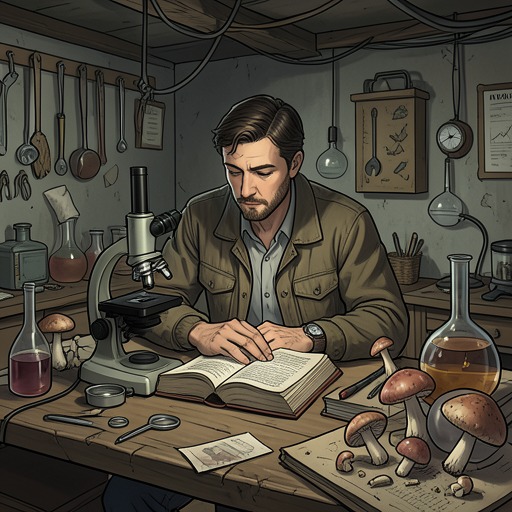
Beug had a degree in environmental chemistry, not formal training as a mycologist. In the mid-1970s, however, he was a young professor at Evergreen State College mycology campus, a new experimental college in Olympia, Washington, where students could design independent courses of study. He agreed to take under his wing Stamets, Jeremy Bigwood, and Jonathan Ott, three students with an intense interest in fungi. Rather than inherit a finished curriculum in their specialty, the four learned the subject together.
Their shared work had practical resources behind it. They used an electron microscope, and Beug had secured a DEA license that enabled their research. The group focused on Psilocybe, a genus that most of the mycological field tended to avoid discussing. Psilocybin mushrooms had been illegal since 1970 and were chiefly associated with counterculture use, while basic knowledge of their habitats, distribution, life cycles, and potency remained limited. The group’s research therefore addressed a subject that was both scientifically underdescribed and socially charged.
From Study to Field Knowledge
The Evergreen group identified and published three new psilocybin species, worked out ways to grow them indoors, and developed techniques to measure psilocin and psilocybin levels in mushrooms. These were distinct contributions: taxonomy expanded the list of known species, cultivation made the organisms more accessible, and chemical measurement offered a means of comparing their contents. Together, the work shifted attention among people interested in Psilocybe away from the assumption that psychedelic mushrooms belonged chiefly to southern Mexico and toward the Pacific Northwest, where the researchers were finding new species around them.
Beug’s role in this account is collaborative rather than solitary. He was not presented as the trained specialist who simply transmitted a body of settled knowledge to his students; instead, he and the students mastered the subject together, using available tools and pursuing questions that other researchers had largely left unattended. That working arrangement links his teaching to the group’s discoveries: the professor’s support and research resources helped turn student enthusiasm into published observations and practical methods. The account does not assign him sole credit for those results, but places him among the people who made them possible.
Testing the Defense-Chemical Hypothesis
Years later, after retiring from teaching and spending relatively little time thinking about Psilocybe, Beug became a source for a question about why mushrooms produce psilocybin. The narrator contacted him at his home in the Columbia River Gorge, 160 miles upriver from a campsite, and found him intrigued by the problem. The question was whether psilocybin might function as a defense chemical, a possibility suggested by the fact that many secondary metabolites in plants protect against pests and disease, sometimes by affecting an animal’s behavior rather than simply killing it.
Beug challenged that explanation by looking at where the chemicals occur in the mushroom. He reasoned that if psilocybin were principally a defense, Stamets would likely have identified a practical antifungal, antibacterial, or insecticidal use for it. Beug’s own tests found only minute quantities of psilocybin and psilocin in the mycelium, the part of the organism most likely to require protection. The fruiting bodies, by contrast, could contain more than two percent of these chemicals by dry weight. The distribution did not prove that psilocybin had no defensive effect, but it made a simple defense explanation less persuasive: the larger quantities appeared in a part that was not, in Beug’s account, the organism’s defensive priority.
Animals and an Evolutionary Possibility
Beug offered a different possibility without claiming certainty. Even if psilocybin began as an incidental product of metabolism, he reasoned, its persistence through evolution suggested that it might have conferred some benefit. His best guess was that mushrooms producing more psilocybin were more likely to be eaten, allowing their spores to travel farther. In this account the chemical’s significance would arise not from a direct service to the mushroom, but from an interaction among the mushroom, the animals that consume it, and the spread of its spores.
He drew on reports as well as conjecture. As the person responsible for gathering mushroom-poisoning reports for the North American Mycological Association, Beug had encountered accounts of horses behaving as though intoxicated in paddocks and dogs that appeared to seek out Psilocybe mushrooms and hallucinate after eating them. Cows, he noted, could appear unaffected; the effects were not uniform across animals. He also pointed to several primate species, apart from humans, known to eat psychedelic mushrooms. Such observations supported the possibility that some animals tolerate or seek altered states, and that their encounters with the mushrooms could help disperse them. They did not establish that animal behavior evolved for that purpose or that every animal benefited.
Beug’s account therefore gives a measured counterpoint to the quasi-mystical idea that psilocybin is nature’s way of communicating a message to humans. He does not replace that poetic interpretation with a demonstrated evolutionary mechanism. Instead, he narrows the question through chemical location, reported animal behavior, and a hypothesis about spore dispersal, while preserving the difference between observation and explanation. His contribution is to make the mushroom’s relation to animals a testable biological problem, not to declare that the problem has been solved.